


When a group decides to go sailing and starts looking at boats, the first question is usually: sailboat or catamaran? Both look appealing in the photos, the prices are different, and it isn’t always clear what you actually get for that difference.
In this article we explain the basic difference between the two types of boat and compare them on what really matters to people on holiday: stability, space, privacy, the feel of sailing, anchoring and price. By the end, we hope, you’ll know which one suits your group better.
The basic difference: one hull or two
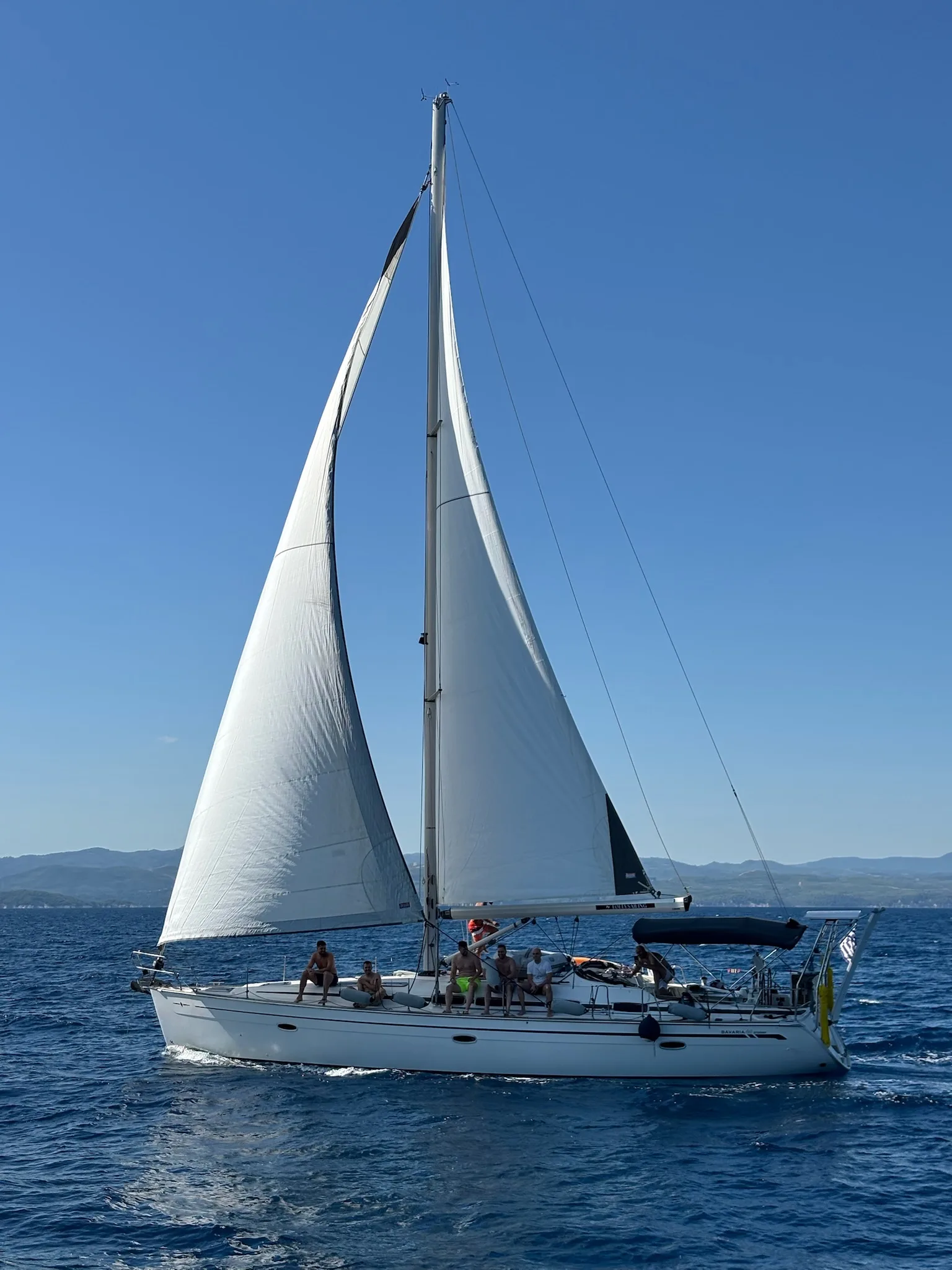
A sailboat (often called a “monohull”) has a single hull with a deep keel underneath. The keel is heavy and acts as a counterweight to the wind in the sails, which is why a sailboat heels over to one side when sailing. That heeling is part of the experience: people who love sailing say it’s only then that you really “feel” the boat. On a sailboat the cabins and saloon are inside the hull, below deck, down a short flight of steps.
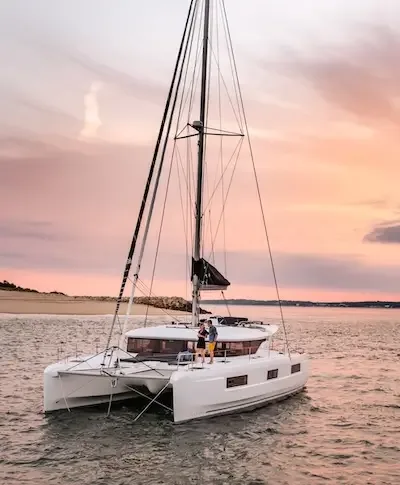
A catamaran has two hulls joined by a wide platform. Instead of a heavy keel, its stability comes from that width, so it hardly heels at all when sailing. The saloon and galley are at deck level, like an apartment with a big terrace, and the cabins are in the hulls on either side.
Almost every other difference follows from this one: how the boat behaves in waves, how much space it has, where it can anchor and how much it costs.
The boats you’ll most often see are sailboats of 13 to 15 metres, such as the Bavaria Cruiser 46, Beneteau Oceanis or Jeanneau Sun Odyssey 49, and catamarans of 11 to 14 metres, such as the Lagoon 40, 42 and 46 or the Excess 11. Although catamarans are often shorter, their width gives them considerably more space.
Stability and motion
For most guests this is the most important difference. A catamaran barely heels under sail, and at anchor, when a speedboat goes by and kicks up a wake, it rocks much less. A glass left on the table usually stays where it is. For people who worry about seasickness, families with small children and older guests, that’s a real advantage.
A sailboat heels when sailing, sometimes noticeably, and rolls more in the waves. For sailing enthusiasts that’s part of the charm, but some people find it uncomfortable, especially in the first few days. It’s worth saying that heeling is completely normal and safe: a sailboat is designed to always come back upright.
Space and comfort
Thanks to its width, a catamaran has more space almost everywhere: a big cockpit, a saloon with panoramic windows, a spacious galley and a wide foredeck, often with a net (the trampoline) where you can lie above the water. The cabins are usually brighter, and many have their own bathroom.
On a sailboat the space is more compact but well used. The cabins are comfortable and the saloon is pleasant, but there’s less daylight below deck, and most of the day is spent in the cockpit. For six to eight people who know each other well, it’s usually plenty.
Privacy
On a catamaran the cabins are split between two separate hulls, so two families or two couples can each have “their side” of the boat. On a sailboat the cabins are closer together, usually at the bow and stern with the saloon in between. If the people on board don’t know each other well or want more peace and quiet, the catamaran has the edge.
The feel of sailing
Here the sailboat wins. When the wind fills the sails, the boat heels and starts to slice quietly through the waves, and that’s the feeling that makes so many people fall in love with sailing. A sailboat sails better closer to the wind, and the helm is more direct and more rewarding for anyone who wants to learn.
A catamaran is a sailing boat too and does sail, but it feels different: calmer, flatter, more like cruising than sport. On longer passages and in light winds the engine is used more often.
Anchoring and shallow bays
A catamaran has a shallow draft, meaning it doesn’t need much depth, so it can get closer to the beach and anchor in shallow bays. Swimming is easy too, because you step straight into the water from the platforms at the stern.
Because of its keel, a sailboat has a deeper draft and anchors a little further from shore. In practice this is rarely a problem, but in some small bays a catamaran has more options.
Marinas and harbour fees
Because of its width, a catamaran takes up more room in a marina. In some harbours it’s harder to find a berth for one when it’s busy, and harbour fees for catamarans are usually higher than for sailboats of the same length. That’s why skippers on catamarans often spend more nights at anchor in a bay, which suits many guests just fine.
Price
On average a catamaran is noticeably more expensive than a sailboat of similar size, both to charter and in fuel and marina costs. Once the price is split between everyone on board, though, the difference per person is often smaller than it first looks, especially if the catamaran comfortably takes more people. For example, in our offer sailboats start at €290 and the Lagoon 46 catamaran at €599 per person for a week.
In short
| Sailboat | Catamaran | |
|---|---|---|
| Stability | heels when sailing, rolls more | hardly heels, calmer at anchor too |
| Space | compact, well used | much more space and light |
| Privacy | cabins closer together | cabins in two separate hulls |
| Feel of sailing | the real sailing experience | calmer cruising |
| Shallow bays | anchors further from shore | gets closer to the beach |
| Marinas | easier to find a berth, lower fees | takes more room, higher fees |
| Price | more affordable | more expensive |
Who each one suits
We’d recommend a sailboat for:
- groups of friends who want the real feel of sailing,
- anyone for whom budget is an important factor,
- people who’d like to learn a bit about sailing and helming during the week,
- those who don’t mind a bit more wind, because that’s when a sailboat shows what it can do.
We’d recommend a catamaran for:
- families with small children and older guests,
- anyone who worries about seasickness or isn’t sure how they’ll feel at sea,
- two families or a larger group for whom privacy matters,
- those who put comfort ahead of the sailing experience and love nights at anchor in quiet bays.
Of course, these aren’t strict rules. Plenty of families have a wonderful time on a sailboat, and plenty of experienced sailors happily choose a catamaran for a relaxed holiday.
Finally
There’s no better or worse boat, only the one that suits your group better. The sailboat is the classic: more affordable, sportier and, for many, “real” sailing. The catamaran is a floating villa: stable, spacious and comfortable, but more expensive.
If you’re still unsure, think about who’s coming on board, how everyone feels on the water, and whether the sailing experience or comfort at anchor matters more to you. And if you need help choosing a specific boat, feel free to get in touch: we’ll gladly tell you from experience what would suit your crew best.