
When people decide to go sailing in Greece for the first time, they almost always get stuck on the same question: where? Greece has more than six thousand islands and islets, and every stretch of coast has its own character, its own wind and its own atmosphere. What’s perfect for a group of friends looking for lively nights out isn’t necessarily ideal for a family with small children, and vice versa.
In this article we compare the three areas most often chosen for a skippered week of sailing: the Sporades, departing from Volos; the Saronic Gulf, departing from Athens; and the Ionian Sea, departing from Lefkada. For each one we explain what the islands are like, what the sailing conditions are, how to get there and who it suits best.
It’s worth saying straight away: none of these three destinations is a “bad” choice. All three are excellent for a first sailing trip, and the differences are more a matter of taste than of quality.
The Sporades (departing from Volos)
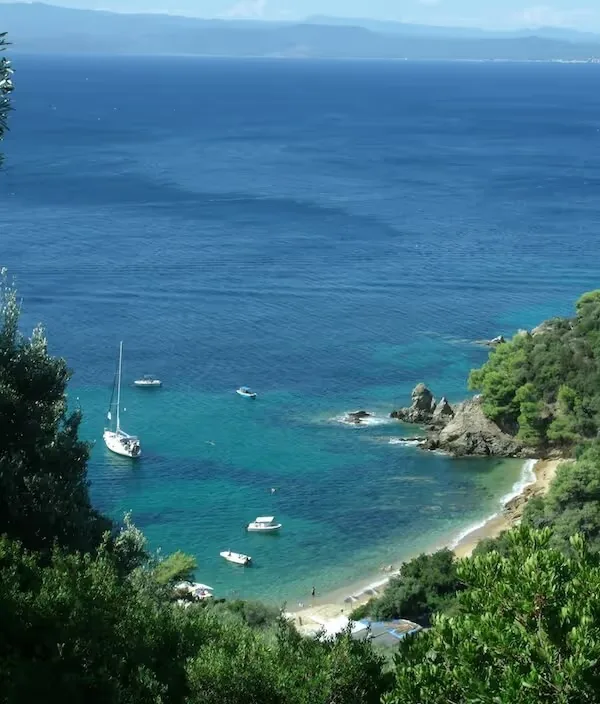
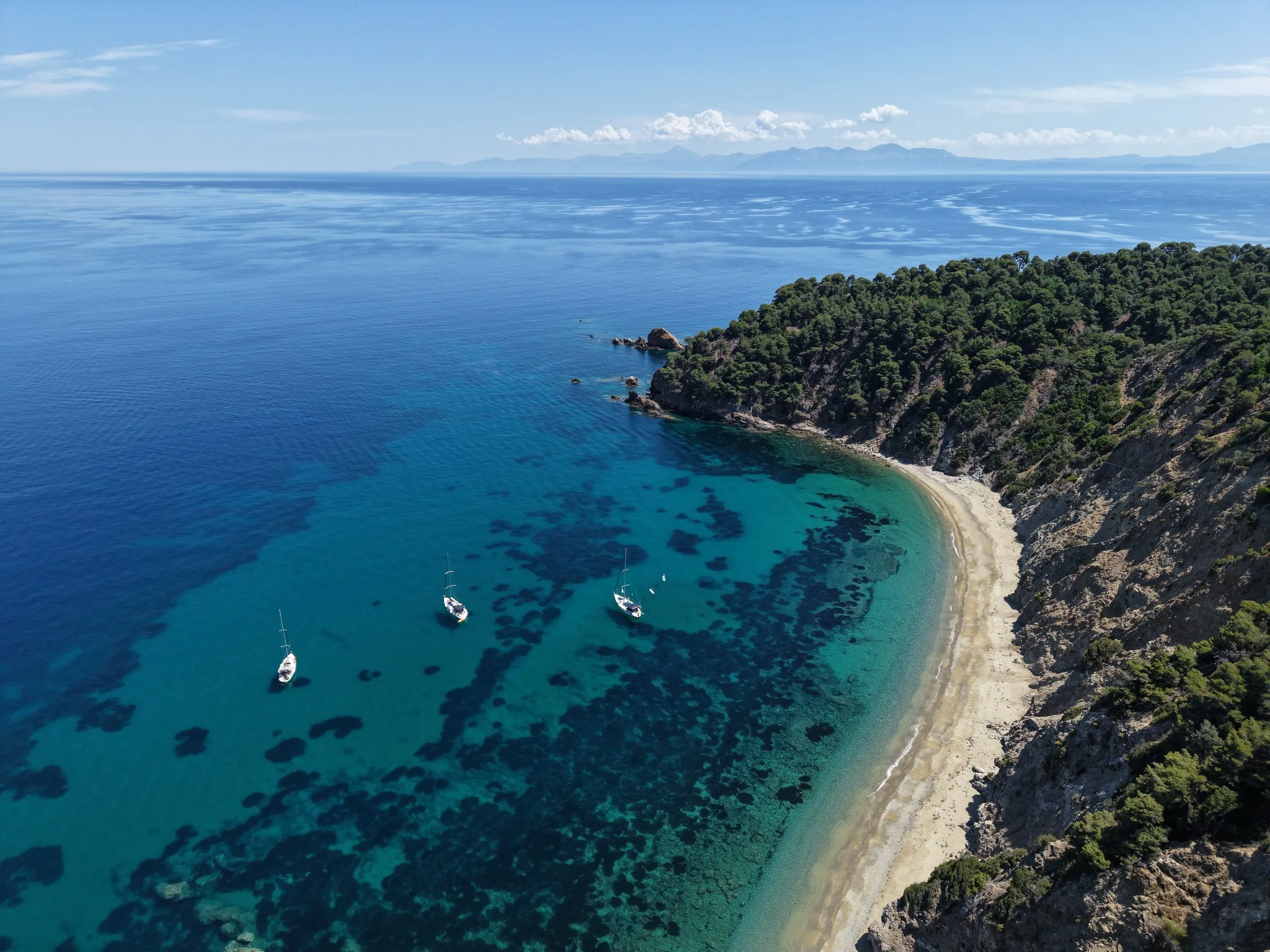
What the islands are like: the Sporades are a group of islands in the northern Aegean, not far from the coast of Thessaly and Mount Pelion. The best known are Skiathos, Skopelos and Alonissos. What sets them apart from most Greek islands is how green they are: pine forests run right down to the sea, so the bays look nothing like the bare, rocky islands most people picture when they think of Greece.
Skiathos is the liveliest, with plenty of sandy beaches and a well-developed tourist scene. Skopelos is calmer, with a picturesque white town on the hill above the harbour and lots of walking trails. Alonissos is the wildest and quietest, and around it lies the National Marine Park, one of the largest marine protected areas in Europe and home to the Mediterranean monk seal. Nearby is the coast of Pelion, with mountain villages and beaches below chestnut forests.
Sailing conditions: distances are short, and there’s plenty of shelter between the islands and the mainland. The meltemi can blow in summer, but the islands soften it considerably, and the skipper always looks for the lee side. For a first sailing trip this is a very forgiving area.
Getting there: the closest major airport is Thessaloniki, about two and a half hours from Volos by car or bus. Athens is the other option, with more international flights, and from there it’s around four hours by road. Of the three areas this one has the longest transfer, but in return you get the greenest and quietest islands.
Who it suits best:
- first-time sailors who want a calm, relaxed week,
- families with children, thanks to the short passages and many sandy beaches,
- nature lovers, walkers and snorkellers,
- anyone happy to travel a little further for greener, less crowded islands.
The Saronic Gulf (departing from Athens)
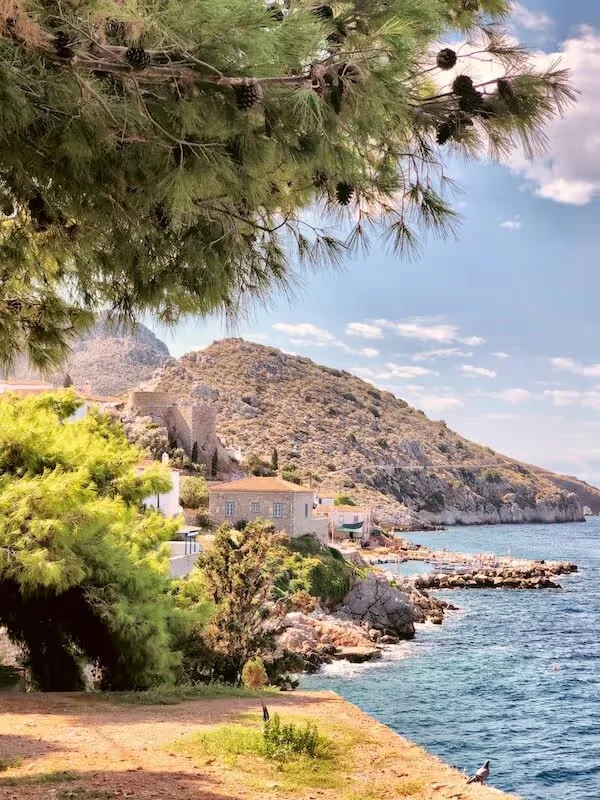
What the islands are like: the Saronic Gulf lies right in front of Athens, between Attica and the Peloponnese peninsula. The islands are relatively small and close to one another, and each has a different character. Aegina is known for its pistachios, the ancient Temple of Aphaia and the Monastery of Saint Nektarios, one of the most visited Orthodox shrines in Greece; Agistri for its pine forest and turquoise water; and Poros for its picturesque harbour and the narrow channel to the mainland. Hydra is a story of its own: there are no cars, and its stone streets and captains’ mansions make it one of the most beautiful towns in Greece. Further south are Dokos, an almost uninhabited island next to Hydra with a large, quiet bay that’s a favourite for a night at anchor, then Spetses and the coast of the Peloponnese, with places such as Epidaurus and its ancient theatre.
This is the area where the sea and history are most closely intertwined. Every harbour is also a holiday spot, with cafés, tavernas and lively evenings.
Sailing conditions: passages are short, and the islands and the coast of the Peloponnese offer plenty of shelter. In summer you can feel the meltemi, especially in the more open stretches to the south, but it’s easy to plan around. Inside the gulf the sea is mostly calm.
Getting there: this is the easiest of the three. Athens is one of the best-connected airports in the region, and the marinas are a short drive away. Another advantage is that a week on board is easy to combine with a few days in Athens, before or after sailing.
Who it suits best:
- those who want a mix of sea, history and lively towns,
- groups of friends who enjoy evenings in harbour and a buzzing atmosphere,
- anyone who wants the shortest possible trip from the airport to the boat,
- those who’d like to combine sailing with a visit to Athens.
The Ionian Sea (departing from Lefkada)
What the islands are like: the Ionian Sea is on the western side of Greece, facing Italy. Lefkada is linked to the mainland by a bridge, and around it lies a whole chain of islands ideal for sailing: Meganisi, with bays where you anchor in complete silence; little Kalamos and Kastos; Ithaca, the island of Odysseus, with sheltered inlets and quiet villages; and northern Kefalonia, with the famous Fiskardo and Assos.
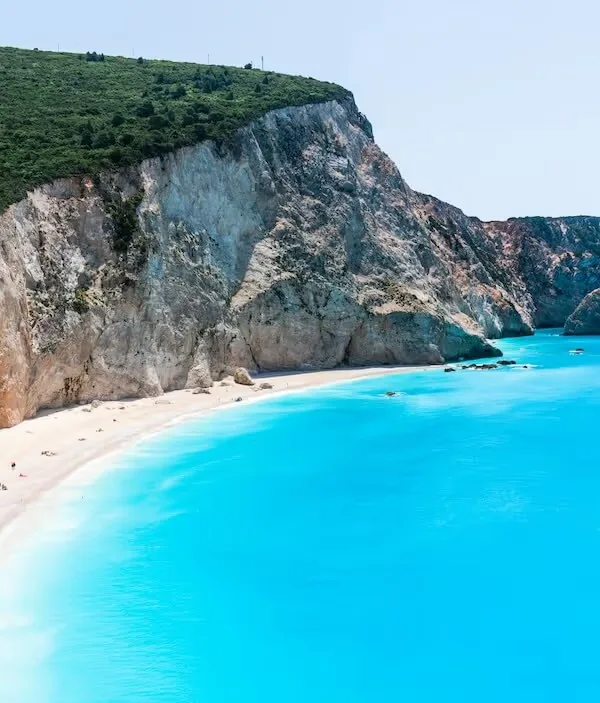
The sea here is perhaps best known for its colour: turquoise-blue water and white rocks that look straight off a postcard. Some of the most beautiful beaches, such as those on Lefkada’s west coast, are best seen from a boat. The islands are green, with olive groves and cypresses, and the villages are smaller and quieter than in the Saronic Gulf.
Sailing conditions: the Ionian is considered one of the calmest sailing areas in Greece. Mornings are often almost windless, and in the afternoon a moderate north-westerly usually picks up, pleasant for sailing. The strong summer meltemi typical of the Aegean doesn’t blow here. That’s why many people recommend the Ionian as the ideal place for anyone nervous about waves or seasickness.
Getting there: the nearest airport is Preveza, about twenty minutes’ drive from Lefkada, but flights there are mostly seasonal and often not direct. A common alternative is to fly to Athens and continue by car or bus, a journey of around four and a half hours.
Who it suits best:
- those who want the calmest sea and the gentlest wind,
- couples and families looking for nature, quiet anchorages and small villages,
- anyone sensitive to the boat’s motion who wants the most comfortable sailing,
- everyone for whom the colour of the sea and the bays are worth a longer journey.
At a glance
| Sporades | Saronic Gulf | Ionian Sea | |
|---|---|---|---|
| Departure | Volos | Athens | Lefkada |
| Character | green islands, pine forests, sandy beaches | history, lively towns, close to Athens | turquoise sea, quiet bays, small villages |
| Summer wind | moderate to strong, with plenty of shelter | moderate, stronger in open stretches | gentlest, pleasant afternoon breeze |
| Getting there | fly to Thessaloniki (≈2.5 h by road) or Athens (≈4 h) | fly to Athens, marinas close to the airport | fly to Preveza (seasonal) or Athens (≈4.5 h by road) |
| Best for | first-timers, families, nature | groups, lively atmosphere, combining with Athens | peace and quiet, those sensitive to waves, couples |
How to choose
If you still can’t decide, a few questions may help:
- Do you want to be on board soon after landing? The Saronic Gulf, close to Athens airport, is the most convenient choice.
- Is a calm sea your top priority? The Ionian is usually the calmest, especially in July and August.
- Do you love lively evenings, cafés and strolling through historic towns? You’ll probably like the Saronic Gulf best.
- Are you travelling with small children? The Sporades and the Ionian offer shorter passages and more quiet beaches.
- When are you travelling? In July and August, when the meltemi blows in the Aegean, the Ionian has the edge for those who don’t like wind. Outside the main season the differences are smaller.
Keep in mind, too, that the route isn’t fixed. The departure marina determines the area, but the skipper chooses where to sail each day based on the weather and the crew’s wishes. If there’s something you particularly want to see, such as a certain island, beach or village, just mention it at the start, and custom routes are possible too.
Finally
A first sailing trip rarely depends on which area you chose; it depends far more on who’s on board with you and how willing you are to slow down to the rhythm of the sea. Still, if you pick an area that suits the way you like to holiday, the week will be even better.
Many people come back after their first trip to discover the other two destinations, because each one shows a completely different side of Greece. If you need help deciding, feel free to get in touch and we’ll tell you honestly what we’d recommend for your group and your dates.